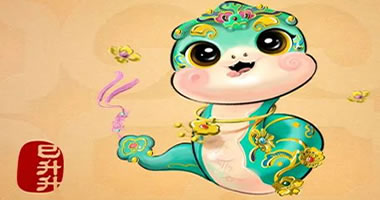
巳升升
2025年春节联欢晚会吉祥物
“春节”列入
《人类非物质文化遗产代表作名录》
联合国教科文组织(UNESCO)于2024年12月4日将中国人庆祝传统新年的社会实践—“春节”列入《人类非物质文化遗产代表作名录》。至此,我国共有44个项目列入联合国教科文组织非物质文化遗产名录、名册,总数居世界第一。
The United Nations Educational, Scientific and Cultural Organization (UNESCO) on December 4th inscribed Spring Festival, social practices of the Chinese people in celebration of traditional new year on the Representative List of the Intangible Cultural Heritage of Humanity.So far, a total of 44 items in China have been included in the UNESCO intangible cultural Heritage list and roster, ranking first in the world.
阅读理解
China Media Group (CMG) unveiled the mascot of its 2025 Spring Festival Gala on Monday.
With the theme of "Year of the Snake, Keep Your Spirits Awake," the vibrant "Si Shengsheng" evokes a sense of "Ruyi," the Chinese concept of expressing the hope for wishes to come true.
In Chinese, the "bat" has the same pronunciation as "blessing." Therefore, with the bat pattern on its forehead and a "longevity" knot at the tip of its tail, the mascot represents both blessings and good luck.
The features of "Si Sheng Sheng" are also deeply rooted in Chinese tradition. The design of its eyebrows and eyes is inspired by the feathered pattern and the "chen" (臣) character motif found on the bronze snake-shaped vessels unearthed at the Sanxingdui Ruins site in southwest China's Sichuan Province. The "chen" character motif also appears widely on bronze and jade wares in the central plains, symbolizing the inclusive and diverse nature of Chinese civilization. The mascot's back is adorned with intricate patterns of Jingtailan, symbolizing "endless vitality," while floral filigree work outlines begonia, magnolia, peach blossom and peony, symbolizing "the return of spring."
Mainly green, this mascot embodies the rejuvenating spirit of spring, and its color scheme is inspired by a rich tapestry of traditional Chinese colors.
CMG's Spring Festival Gala, known in Chinese as "Chunwan," is an essential part of the Chinese New Year celebrations and is deeply cherished by the Chinese people.
Featuring a diverse array of performances – including music, dance, comedy and drama – the gala is much more than an entertainment show. Rather, it symbolizes a time for family gatherings and the joyful ushering in of the new year.
Broadcast on the Chinese New Year's Eve, the gala is watched by more than a billion people, creating a shared experience that enhances feelings of unity and reunion.
In the traditional Chinese zodiac cycle, the Year of the Snake holds a unique and mysterious position. The snake, as an agile and cunning presence among the twelve zodiac animals, carries rich cultural connotations and historical memories.
The expression “Ruyi” in the 2nd Paragraph means all except .
A. Auspiciousness
B. Blessing
C. Trickery
D. Good luck
根据后文...the Chinese concept of expressing the hope for wishes to come true. A项 auspiciousness 吉祥如意;B项blessing 保佑,呵护;D项Good luck 好运。这三项均能体现“the hope for wishes”. 而C项的意思却为:欺骗,哄骗,耍花招。这个完全不符合上下文语境。 x
Which one is true about “Si Shengsheng” in the 4th Paragraph?
A.The pattern and character motif bring its design of eyebrows and eyes.
B.Si Shengsheng embodies the inclusive and diverse nature of Chinese civilization.
C.The "endless vitality" can be found on the mascot's back.
D.The intricate patterns of Jingtailan symbolizes "the return of spring."
第4段第2句话 The design of its eyebrows and eyes is inspired by the... China's Sichuan Province. 已经很明显地反映了A项的正确性。 x
Why does the writer mention “Chunwan" (春晚) in the passage?
A.Because it is an essential part of the Chinese New Year celebrations.
B.Because the gala is much more than an entertainment show.
C.Because it symbolizes a time for family gatherings.
Because it embodies Chinese traditionally cultural connotation.
【推理题】作者通过上下文吉祥图Si Shengsheng, “Chunwan”等来诠释中国人的传统文化--春节。意在“借物抒情”从而渲染“欢乐吉祥、喜气洋洋”的中国文化。其中A. B. C 项均是D项的“体现”。 x